Before you go smart, get lean: A reality check for manufacturers
Julkaistu 14. heinäkuuta 2026: Operational Excellence
Before you go smart, get lean: A reality check for manufacturers
Manufacturers today investing in connectivity, automation, and real-time data visibility are targeting measurable outcomes: higher OEE, shorter cycle times, reduced energy consumption, better quality control.
However, a significant share of digitalisation projects fall short of those targets. Pilots succeed on a single line and never scale. Dashboards are built but the decisions they were meant to inform still get made on gut feel and spreadsheets. Budgets are spent, and the production KPIs look largely the same twelve months later. The technology worked. The transformation did not. What is actually getting in the way?
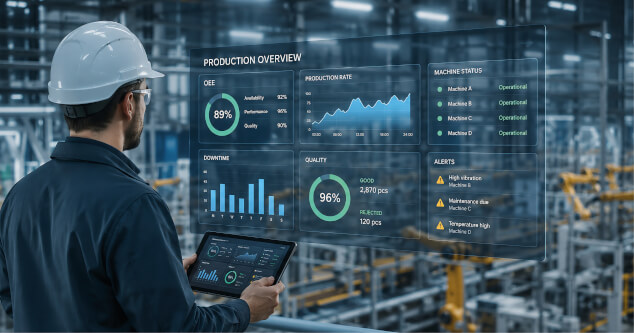
5 reasons why many digitalisation projects fail
The problems tend to cluster around the same set of recurring issues, and most of them have nothing to do with the technology selected.
- The first is process standardisation, or the lack of it. Connecting a machine to a data platform does not make the process running on that machine consistent or repeatable. Sensor data collected from an unstable process is noisy, hard to interpret, and unreliable as a basis for automated decisions.
- Closely related is the digitisation of inefficient processes. Automating a poorly designed workflow does not improve it. It accelerates it, and locks it in. Manufacturers who skip the process improvement step and move directly to digital implementation often find themselves with faster, more connected versions of the same problems they started with.
- A third failure mode is the gap between shop floor data and management decision-making. Data gets collected at machine level but never reaches the people responsible for production targets, capacity planning, or quality commitments. The KPIs that matter to an operations manager or plant director are often not the ones being monitored at the line. When these two layers are not aligned, the data infrastructure serves reporting rather than decisions.
- Then there is the state of OT on the shop floor itself. In practice, a typical production environment contains machines from multiple manufacturers, with different PLCs, different communication protocols, and different levels of connectivity. Some have no network connection at all. Getting reliable, standardised data out of that environment requires IT and OT expertise working together, and those two functions often sit in separate teams with separate priorities and separate budgets. The result is that integration projects stall, take far longer than planned, or produce data that is inconsistent and therefore not trusted.
- Large manufacturers face an additional structural challenge. Over years of acquisitions, plant expansions, and individual line investments, many have accumulated a patchwork of systems: tailor-made configurations, proprietary integrations, and bespoke software. Adding a new data platform on top of that architecture without first addressing the underlying fragmentation tends to add complexity rather than clarity.
Smart manufacturing without lean? Think again.
Lean manufacturing and digitalisation serve different but complementary purposes, and together they are considerably more powerful than either one alone. Lean defines what needs to be improved and why, for example identifying waste across the eight categories of overproduction, defects, waiting, transportation, overprocessing, inventory, motion, and unused talent, and establishing the process discipline that makes improvement measurable and repeatable. Digitalisation then provides the means to accelerate those improvements, make them visible in real time, and scale them across lines and sites.
Starting with lean methodology creates the right conditions for a successful digital deployment. A process that has been assessed, stabilised, and standardised gives the digital layer a solid foundation to build on. Data collected from a well-understood process is cleaner, more consistent, and far easier to act on. That foundation is also what makes scaling realistic: when the time comes to extend the approach to additional lines or sites, the framework is already validated and the variables are known.
The approach also reduces implementation risk. Pilots built on lean-prepared processes are more predictable, easier to replicate, and less likely to require costly rework further down the line.
Underlying all of this is the principle of continuous improvement. A single project cycle rarely delivers the full picture, nor should it be expected to. The approach that generates lasting results is iterative: assess, implement, evaluate, and return to build on what the previous cycle achieved. Each iteration adds to the last, and the combination of lean discipline and digital capability compounds in value over time.
A practical roadmap in 4 steps
The manufacturers that navigate this successfully tend to follow a similar sequence.
- The process starts with a structured assessment: direct observation on the shop floor, interviews with operators and production managers, and a review of current KPIs against targets. The goal is to identify, with specificity, where the process is losing value and why.
- From that comes prioritisation. The high-impact problems become the scope of the first improvement cycle, with clear, measurable targets. Not "improve OEE" but "reduce unplanned downtime on line 3 from 18% to under 10% in the next quarter."
- A pilot on that defined scope then validates both the technical approach and the organisational change needed to sustain it. Designing it to be repeatable from the outset is critical, so the same approach can be transferred to other lines without starting from scratch.
- Scaling follows once the pilot is confirmed. The investment in lean methodology and process standardisation pays off here, as the same framework applies to additional lines with significantly lower effort and risk.
How OMRON can support
Translating a roadmap like this into practice requires expertise across process improvement, OT, and IT. These three disciplines are rarely found under one roof.
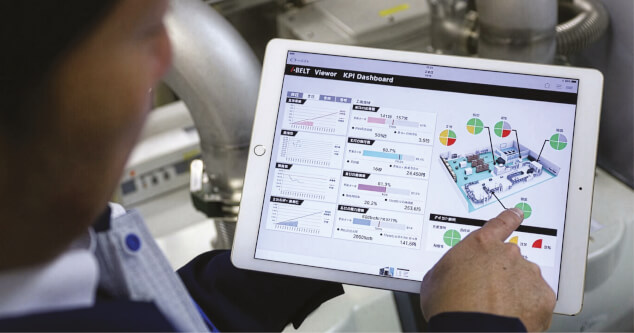
OMRON's i-BELT service was built specifically to address that gap. The name reflects the same logic as the belt system in quality management, where competence builds progressively, each stage grounded in what came before.
Starting with a structured shop floor assessment, OMRON's team of manufacturing consultants, IT-OT architects, and data specialists identifies the highest-priority improvement opportunities and takes ownership of delivery from pilot through to scaled implementation. i-BELT works with the machines, PLCs, and IT systems already in place, identifying what is missing and integrating selectively. Demonstrated results include OEE improvements of 5 to more than 30%, alongside reductions in cycle time, scrap, and energy consumption.
For more information, please visit: i-BELT Data Services
Contact us for more information