Virtual commissioning: Reducing costs and improving machine validation
Julkaistu 01. lokakuuta 2025: Industry 4.0
How can virtual commissioning eliminate costly confusion and empower manufacturers to innovate with confidence?
“We didn’t talk about it because I expected you to know” is a phrase I have heard a lot over the years.
Poor communication is the number one reason why industrial automation projects don’t go to plan at the commissioning stage. Whether it is a new machine, a new cell or an entire line, misunderstandings often arise between project partners about how the design should look. Consulting the documentation doesn’t always help, because inaccurate, vague or incomplete information is often what caused the disagreement in the first place.
Miscommunication around inputs, outputs and interfaces is a prime example. A systems integrator might assume that a piece of equipment uses EtherCAT, while the manufacturer expects Profinet. Or perhaps a line integrator forgets to mention a sensor capturing additional information that is important for machine safety. In both cases, the result is the same: added cost, wasted time, and mounting frustration for all parties involved.
The solution is simple: don’t let humans produce the specification alone. Virtual commissioning results in far more accurate specifications.
What is virtual commissioning?
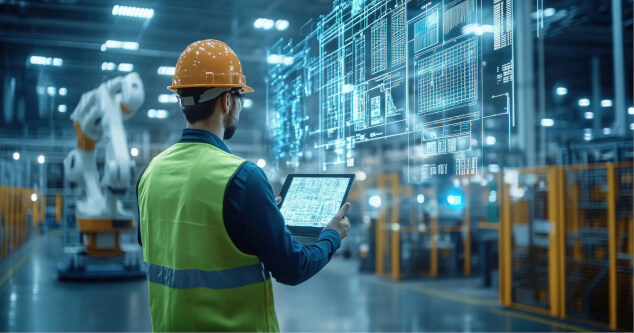
The first point to emphasise is that virtual commissioning is not the same as simulation. Simulation is about testing out ideas, exploring ‘what if’ scenarios, and determining what is and isn’t possible. Virtual commissioning builds on that by enabling the testing of entire manufacturing systems in a virtual environment.
This ensures that potential issues are identified and resolved before physical commissioning begins. It also provides a platform for generating precise system specifications, eliminating much of the guesswork that creeps into traditional project workflows.
It relies on Model-In-the-Loop (MiL), Software-in-the-Loop (SiL), Hardware-in-the-Loop (HiL) and digital twins to create the optimum machine and line set-up. The result is not just a model, but a robust foundation for physical implementation.
The secret here is simpler than you might expect: setting up sub-meters. With sub-meters, you get visibility into where energy is actually going, whether it’s specific lines, zones, or even individual machines. And while it may seem too simple, sub-metering lets you isolate energy hogs, spot idle consumption, and in the end, help you set real KPIs.
Beyond just power, production environments also need to monitor related metrics like air flow, cooling systems, even compressed air usage. Flow sensors, thermal sensors, and pressure transmitters are your friends here. They’re cheap insurance against waste and a strong foundation for carbon reporting.
As Stefan Jensen adds, more customers will be asking for your energy footprint per part, and the hard truth is, that if you can’t give them real numbers, someone else will.
Four key applications
1. Producing a digital blueprint
Virtual commissioning eliminates ambiguity by extracting details about tolerances, performance, software interfaces and more to generate precise system specifications. The resulting digital blueprint removes confusion and streamlines installation.
Once created, this blueprint can be reused as a “copy and paste” tool for replicating lines across multiple sites. Manufacturers benefit from consistency, faster roll-outs, and a reliable way to scale up production capacity without reinventing the wheel each time.
2. Cutting post-installation time and cost
A major line builder once told me that when building a new line, only 20% of the total cost is in design, purchase and installation. The other 80% comes afterwards, through debugging, integration and getting the line to run smoothly. Smoothing out all errors post-installation takes, on average, 12 months.
Virtual try-outs prevent this by testing process flows, machine interactions and even operator interventions in advance. These digital rehearsals provide critical insights into potential bottlenecks and failure points. By resolving them in the virtual world, companies prevent downtime and costly surprises in the real one.
3. Building future-proof production lines
With a comprehensive digital twin, companies can explore configurations, adjustments and scaling options without the expense of physical changes. As market demands evolve or volumes fluctuate, lines can be adapted with confidence. This agility is crucial for manufacturers navigating uncertainty, new product launches or supply chain volatility.
4. Putting safety systems to the test
In environments such as EV battery production, the difference between safety systems working and failing is life or death. Electric shocks, chemical exposure and heavy loads all pose risks. Testing such systems in real conditions is difficult, especially as safety functions are rarely limited to one machine.
Virtual commissioning allows thorough testing of safety strategies in a controlled environment that replicates real production. Builders gain a true picture of how machines and lines will react to safety infringements, without exposing operators to risk.
Challenges to overcome
The value of virtual commissioning is clear, but companies must address some practical challenges.
1. Getting started
Many companies understand the benefits but struggle to define clear objectives. Virtual commissioning works best with a roadmap, management buy-in and alignment between software, mechanical and electrical teams. A structured pilot project is often the smartest first step.
2. Data accuracy
The heart of virtual commissioning is the digital twin. If the data behind it is outdated or inaccurate, the virtual model won’t match real-world performance. Data consistency and validation are therefore essential from the very beginning.
3. Integration and coordination
Virtual commissioning requires close collaboration between engineering disciplines, each with its own tools and standards. Shared environments and predefined function blocks help bridge these gaps. For example, OMRON and Dassault Systèmes have developed IT/OT function blocks usable both virtually and physically.
4. IT infrastructure
Running complex simulations continuously demands robust IT systems. Hardware, software, cyber security and integration with existing IT must all be in place for virtual commissioning to succeed.
How AI is changing the game
AI and machine learning are making virtual commissioning even more powerful. By learning from historical and real-time data, digital twins can mirror physical systems more closely than ever before.
AI-driven models can predict failure modes, suggest corrective actions and refine processes automatically. They also ease collaboration between engineering teams by offering insights across mechanical, electrical and software domains. The outcome: higher accuracy, faster optimisation and fewer costly mistakes.
Much more than a digital replica
Virtual commissioning isn’t just creating a digital copy. It is an integrated approach that helps businesses innovate with confidence, align project stakeholders and avoid costly misunderstandings. It leverages digital tools to optimise manufacturing processes before physical installation.
And with AI and machine learning in the mix, virtual commissioning is evolving from a validation tool into a proactive driver of continuous improvement. The insights will only get deeper, the models more robust, and the process more streamlined.